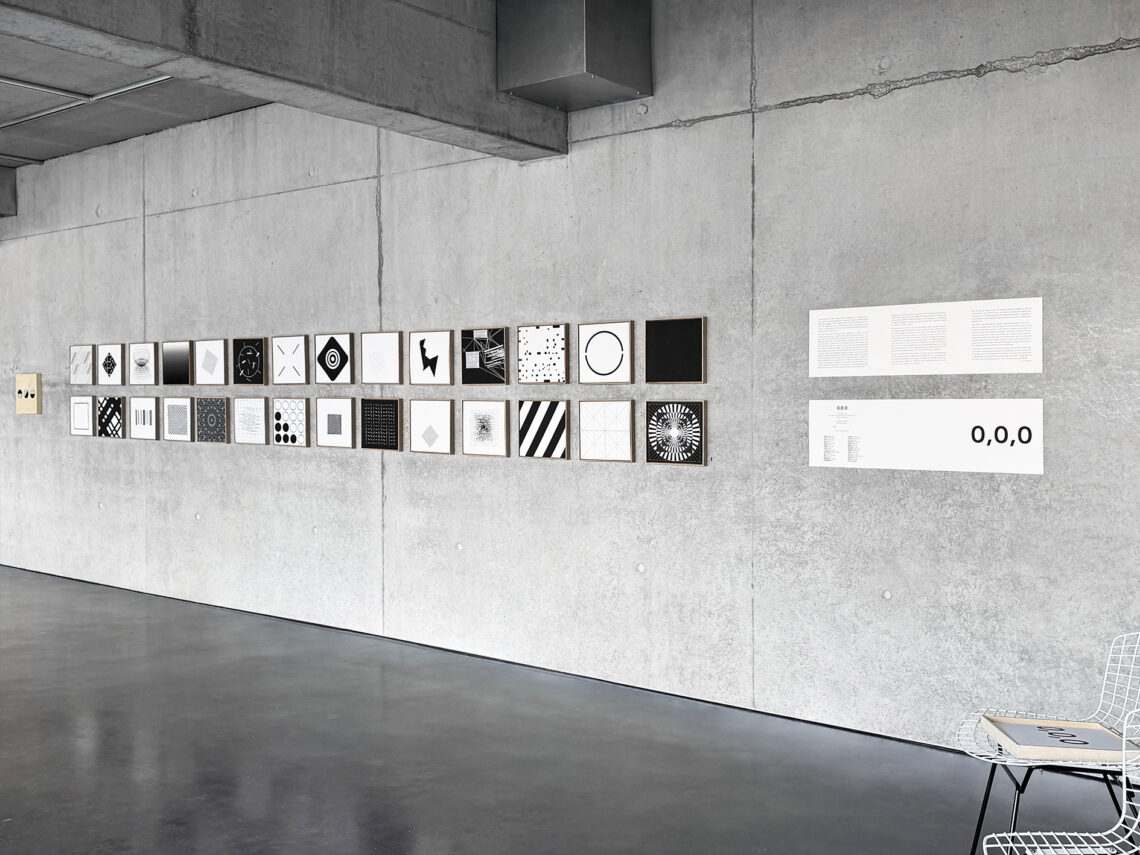
0,0,0 – From the Black Square to the Digital Zero Point
A Turning Point in 1915
Commemorating the 110th anniversary of the 0,10 exhibition in Petrograd, this portfolio brings together thirty works by non-figurative artists from around the world. Held in 1915, amid war and revolutionary unrest, the exhibition marked a decisive turning point in art history. In particular, it introduced Kazimir Malevich’s Black Square, a work that would redefine artistic language.
The Radical Break of the Black Square
At a time of deep social and political upheaval in Tsarist Russia, established norms were widely questioned. In this context, Black Square emerged as a radical rupture with centuries of representation. It proposed a “zero form,” deliberately rejecting tradition. As a result, it crystallized Malevich’s Suprematist vision, in which art is freed from depiction and guided by the “supremacy of pure feeling.”
Moreover, this bold gesture echoed the revolutionary spirit of the avant-garde. It also aligned with the iconoclastic energy of Russian Futurism, which attacked bourgeois conventions. Significantly, the painting’s placement in the exhibition corner gave it the status of a secular icon for modernity.
From Suprematism to Constructivism
From this foundational break, a new movement soon emerged: Constructivism. It developed a visual language based on geometry, industrial materials, and technology. Consequently, Constructivism spread rapidly across the globe.
However, as it expanded, it adapted to different cultural and political contexts. Despite these variations, it retained its core principle of reduction. In this sense, it demonstrated that simplicity can generate innovation. Today, this principle resonates strongly, especially in the algorithmic logic that shapes digital creation.
0,0,0: A Digital Parallel
The title 0,0,0 reflects this historical lineage. In the Python language, it represents the color black in its most basic state. Therefore, it echoes the idea of reduction to elementary forms.
Just as Black Square introduced a “zero form,” 0,0,0 functions as a starting point in the digital realm. From this minimal basis, countless visual and functional structures can emerge. Thus, the portfolio establishes a direct parallel between early abstraction and contemporary code.
A Global and Contemporary Perspective
The thirty artists featured here each pursue reduction in their own way. At the same time, they explore diverse visual possibilities within limited vocabularies. As a result, the portfolio highlights the global evolution of non-figurative art.
Importantly, this development did not occur solely through Constructivism. Instead, non-representational practices emerged independently across cultures. Therefore, 0,0,0 presents a broader, transcultural perspective on abstraction.
Art as Code
This portfolio can also be understood as an analogy. It presents thirty works as thirty “lines of code.” Similarly to programming languages, these works rely on modular and combinatorial principles.
Consequently, complex artistic systems arise from simple elements. In the digital age, this parallel becomes especially relevant. Indeed, code now underpins most visual and interactive experiences. For this reason, the avant-garde’s search for a pure visual language gains renewed significance.
An Open Framework for the Present
Ultimately, 0,0,0 invites viewers to reconsider the legacy of Constructivist ideas. On the one hand, it shows their continued influence on creativity and innovation. On the other hand, it emphasizes their role in fostering cross-cultural exchange.
Thus, the project presents Constructivism not as a closed chapter, but as an evolving toolkit. It reflects each era’s aspirations for art, technology, and society. In this way, 0,0,0 becomes both a void and a mirror, open to new interpretations and future possibilities.
The Artists
Amrein Serena (CH)
Bahk Seon Ghi (KR)
Balart Waldo (CU)
Belov Ivan (RU)
Chardon Nicolas (FR)
Cigler Václav (CZ)
Crespin Elias (VE)
Ernst Rita (CH)
Fiorelli Emanuela (IT)
Hersberger Marguerite (CH)
Jaar Alfredo (CL)
Kien Jean-Charles (FR)
Lee Jeewi (KR)
Linschinger Josef (AT)
Macaparana (BR)
Megert Christian (CH)
Morandini Marcello (IT)
Mori Taiyoh (JP)
Moutashar Mehdi (IR)
Mujica Felipe (CL)
Nabavi Nima (IR)
Niemeyer Jo (DE)
Ostarhild Jurgen (DE)
Queloz Philippe (CH)
Rhode Robin (SA)
Ridell Torsten (SE)
Soto-Díaz Mariángeles (VE)
Staudt Klaus (DE)
Strunz Katja (DE)
Van der Ploeg Jan (NL)